Wednesday, August 12, 2009

Biking at DisneyWorld


If you are traveling to DisneyWorld, and biking is something you really enjoy, know that DisneyWorld is bike friendly. You can bring your own (something I've done) or you can rent one of theirs. If you want to rent a bike at DisneyWorld, it has a wide selection of models and styles. Even if you bring your own, the staff goes out of its way to be helpful, provide maps, suggest picnic spots, locations for taking pictures, etc.

Almost all of the hotels within DisneyWorld, both within the park and those on the grounds, offer rentals as well as extensive bike paths (they're not bike exclusive - you do need to watch out for pedestrians and, of course, children). Another item to watch out for is Orlando's weather. In May, June, July, August, and September Orlando is HOT and HUMID. You'll need lots of liquid (which DW will be happy to sell you), a wide-brim hat (ditto) and sunscreen (ditto - at a major markup), as well as an umbrella for the afternoon thunderstorms.

One of my favorite hotels at DW is the Wilderness Lodge. It is on the DW grounds, but not within the park itself (as is, say, the Contemporary Hotel). Its a favorite since it is so un-Florida. It reminds me of the lodges in Yellowstone - which is what it is supposed to do, frankly. It is also relatively newer than some of the other hotels at DW, which are starting to show their age.

For bikers (and runners, too) there is a one-mile trail along a scenic route leading to The Cabins at Fort Wilderness. Since there are joggers here, too, this is no place for speed, but the scenery is beautiful and DW maintenance of the landscaping is first-rate. If you have a 30-mile per day habit, this is no place to put in the time. But if you are satisfied with 5-10 miles (you are on vacation), its tough to find a better place to ride.

For the serious rider, remember you are in Florida - there are no real hills this far south, so your ride will be relatively flat. You can ride on any of the roadways within the DW grounds (the palce is huge), but not all of the roadways have bike paths and/or sidewalks, so you'll be competing with the traffic when you ride on the roads. As you can imagine, the traffic is light early in the morning, so that's the best time to ride. Remember, too, that unless you are accustomed to riding in a large metropolitan area where there are a lot of busses, you will share the road not only with the busses of the DW trasportation system, but all of the tour busses, as well. The DW drivers are generally friendly since their jobs depend on it. The other bus lines may not train their drivers so specifically, however.

Biking at DW is something my kida and I have enjoyed in the past. We hope you do, too!

Wednesday, August 5, 2009

Biking in the Florida Keys


A couple of winters ago, my daughter and I decided we wanted to ride our bikes to Key West that coming summer. As things worked out we were not able to make the trip, but we had a great deal of fun planning and preparing for it!

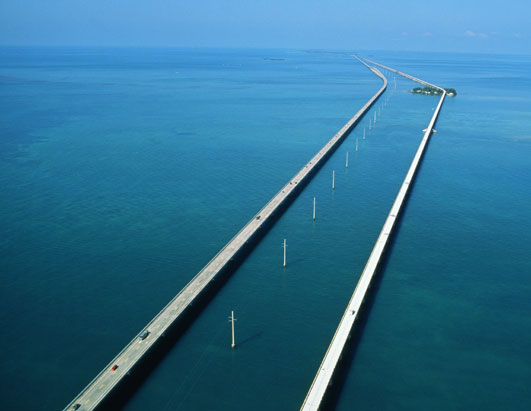
From about mile marker 103 southwest to Key West (which is mile marker 0, by the way), there is a dedicated bake path or bike route. The only exceptions to this are construction areas, the bridges (oh, the views!) and a couple of places where the islands are too narrow to have a bike path.

Experienced bikers will make this trip in one day. But given the distance, the prevailing winds in the Keys, the bridges (oh, the views!), the traffic, as well as the heat, humidity, and rain (for most of the year), that trip is not for the unprepared and especially not for out-of-shape! Merely adventurous bikers will plan the trip for two days (what my daughter wanted), with an overnight stay in one of the Keys' many fine hostelries north of Key West. Slightly dull couch potatoes (me!) however, usually set the trip up for three days (30 to 40 miles per day). We also plan to start the day at about 7:00AM after a high carb breakfast and a great night's sleep. That way the biking is over by about noon, the afternoon is left for napping and otherwise recuperating from the exertions of the morning's exercize, and evenings are left for trying one of the many fine restaurants the Keys have.

Out plan was to drive from Palm Beach Gardens to Key Largo at the north end of the Keys and leave the Explorer with a friend. Then we'd bike from there to Key West over the pre-planned three days. There is only one road to Key West (or any of the Keys for that matter)- US1, locally known as the Overseas Highway. There are sidewalks or bike paths along most of it, thus the ride is fairly safe.

In Key West we planned on staying at the Knowles House (http://knowleshouse.com/) a wonderfully restored B&B far enough off Duval Street to be quiet, but close enough to be close to all of the excitement as well as great restaurants. Wy wife and I, as well as my daughter and I, had stayed there before and loved it. Les & Paul, the owners, know Key West well and cater to an eclectic and friendly clientele. It has a pool, spa, and adult tanning area. They set a great table at breakfast and go out of their way to make sure their guests are comfortable.

But, as I said, the trip was not to be. For both my daughther and me, the infernal interruptions of making a living got in the way. However, it is something we eventually will do (assuming she does not make me a grandfather as her brother has done!). Make the trio! You'll enjoy it!

Monday, August 3, 2009

The National Health Insurance Debate

Sunday (2 August '09) Tim Geithner and George Stephanopolous burned a lot of ABC's airtime on the subject of President Obama's proposed health insurance plan. It is interesting to note what Secretary Geithner did not say. Mr. Stephanopolous pressed him on the subject of paying for the plan, specifically if it was going to be possible to have this health program at no net cost to the middle-class tax payer. What Geithner did not say was "no". He danced around the issue like a parent telling a 10-year old where babies come from. The problem is that, today, way too many 10-year olds know where babies come from, how they get to where they come from, and how much fun it is to put them there. The parent, dancing around the question, looks at best uninformed and, at worst, looks stupid. The non-answer also serves to insult the intelligence of the 10-year old, not to mention pique the kid's natural curiosity.

So Secretary Geithner, instead of answering the question candidly and openly (as in "Hell, yes, we are going to have to raise taxes to pay for this program!") informed us that "...nothing is off the table...", and that those making over $250,000 per year will bear the brunt of the increased costs of national health insurance. Is your intelligence insulted yet?

While there is a lot of persiflage (which is a nice word for "crap") floating around the net about what this plan will and will not do for us, to assume that a sur-tax on the ultra wealthy will be sufficient to pay for it requires the plan to be built on a lot of baseless assumptions. The first is that there are enough rich people to pay for the program. Let's say there were 10 million people in the US making over $250,000 per year. Let's also say this program is going to the US another $1 billion per year over the base cost. $1 billion divided by 10 million is $100 per year per person - nothing, really for somebody making $250,000.

But $1 billion in Washington, DC is chump-change. So let's look at $100 billion. Now that's $10,000 per year per rich person, or 4% of their income. Remember, this $10,000 per year comes from pockets of the "wealthy", but benefits you and me (who pay nothing for it), as well as them (who are paying for it all). Can any one see Karl Marx smiling?

Another erroneous assumption is that there will be at least on person making $250,000 per year for every one that retires, dies, changes profession, loses his/her job, etc. This is patently false and Washington, DC knows it. The baby-boomers are beginning to retire right now and that population cohort will only grow over the next 25-years. Yet the birthrate has slowed to the point that the number of folks working and paying taxes will not keep pace with the number of folks retiring and thus not paying taxes.

Another false assumption is that of the income necessary to pay for the system: $250,000. Let's be pragmatic. If you know that, over $250,000 income, a good chunk of that overage will be lost in taxes, how excited are you going to be to earn that extra money? Why not make just $245,000, thus avoid the tax? Why not make $300,000, but have $55,000 deferred until next year? Is it possible that tax lawyers and CPAs are behind this insurance program?

In reality, the polls indicate that most Americans are generally happy with their health insurance programs and that a European-style program of socialized medicine is not something that will work here. What Washington need to look at seriously is not universal health insurance, but an insurance program to help people through catastrophic or long-term health problems. Clearly the health insurance industry is broken and needs to be fixed. However, it looks like Washington is all worried about replacing the carpet and padding, but the roof still leaks. Is this really what we want?

Let the debate continue!

Sunday, August 2, 2009

Some Interesting and Useless Trivia on Key West


Most people don't know that, during the Civil War, Key West was a Northern town, even though it was part of the Confederacy. Here's what happened:

The US military built Ft. Zachary Taylor on a man-made island approximately 100 yards off the shore from Key West (which was since filled in). Since Key West was a major port for ships that traded in South America and the Carribbean, they needed a southern port close to Cuba, and Key West was only 90 miles from La Habana, an easy day's sail (in good weather). To protect this shipping the US military maintained a base in Key West, including Ft. Zachary Taylor.

When Florida seceded from the Union, both the Confederate Navy and Army were too occupied and spread too thin to worry about a backwater such as Key West. The waters around this island were too shallow for the Confederate's main war ships to attack and liberate it. Since it was not possible to access Key West at that time from land, the Confederate army could not assult the Fort. So it remained in Union hands under martial law thruout the remainder of the war.

The inhabitants of Key West were not all that upset since Union naval and army troops continued to invest their pay with the city's merchants, bars, and brothels. Merchant ships continued to call at this port, which was fine with the townspeople and the Union liked the goods that came in and then went out again on ships flying the Stars and Stripes. The fact that Confederate spies came and went on those ships was not lost on the Union, nor did the Confederacy waste that intelligence.

So, without going into great detail, this is how and why Key West was a Union town in a Confederate state.